Understanding the Core Differences
When we outfit our .300 Win Mag rifles, one of the most critical decisions we face concerning our optics is the choice between a First Focal Plane (FFP) and a Second Focal Plane (SFP) scope. This isn’t merely a matter of preference; it fundamentally alters how we interact with our reticle and, by extension, how effectively we can employ our rifle at various distances. The .300 Win Mag is a formidable cartridge, capable of delivering energy and precision far beyond what many perceive as “standard” hunting ranges. Therefore, our optic must complement this capability, ensuring that we can maximize its potential in whatever role we assign it.
The core functional difference between these two reticle designs lies in their placement within the scope’s optical system. In an FFP scope, the reticle is positioned in front of the magnification erector system. This means that as we adjust the magnification, the reticle itself appears to grow larger or shrink smaller in proportion to the target image. Consequently, all the holdover, windage, and ranging hash marks on an FFP reticle remain consistently accurate at every magnification setting [2, 8, 9]. This constant proportionality is a significant advantage, particularly when we are engaging targets at varying distances and require precise holdovers or quick ranging.
Conversely, in an SFP scope, the reticle is located behind the magnification erector system. The immediate effect of this design is that the reticle appears to maintain the same size, regardless of the magnification setting we select [2, 10, 12, 13]. While this might seem appealing for its visual consistency, it introduces a crucial caveat: the hash marks and subtensions on an SFP reticle are only truly calibrated and accurate at one specific magnification setting, which is almost always the scope’s maximum power [2, 10, 12, 13]. If we deviate from this calibrated magnification, our holdover points and ranging estimations will no longer be correct, necessitating either mental calculations or a return to the designated power setting.
Reticle Behavior at Varying Magnification
Let’s delve deeper into how these fundamental differences manifest themselves when we’re actually using our .300 Win Mag. With an FFP scope, imagine we are ranging a distant target at 10x magnification, using our reticle’s ranging features. If the mirage becomes too distracting, or we need a wider field of view, we can drop down to 6x magnification, and those same ranging features will still be accurate. The subtensions—the angular measurements represented by the hash marks—don’t change relative to the target [5, 6, 12]. This allows us unparalleled flexibility. We can adjust our magnification to suit environmental conditions, such as mirage or target acquisition speed, without compromising the integrity of our holdover points. This is incredibly valuable for long-range engagements where conditions can change rapidly.
For an SFP scope, the experience is quite different. The reticle maintains its visual size, offering a consistent appearance regardless of magnification. This can be beneficial for those who prefer a bold, unchanging reticle. However, if our SFP scope is calibrated for 18x magnification, and we are spotting a target at 9x, any holdover marks we attempt to use will only be half of their true value. We would either need to adjust our hold accordingly, or, more commonly, we would need to zoom all the way to 18x to use the reticle as intended. This limitation can introduce delays and potential errors, especially under pressure or when time is of the essence.
When choosing the right scope for your .300 Win Mag rifle, understanding the differences between First Focal Plane (FFP) and Second Focal Plane (SFP) scopes is crucial for optimal performance. For a deeper dive into this topic, you can check out a related article that explores the advantages and disadvantages of each type of scope, helping you make an informed decision based on your shooting style and needs. For more information, visit this article.
Implications for .300 Win Mag Long-Range and ELR Shooting
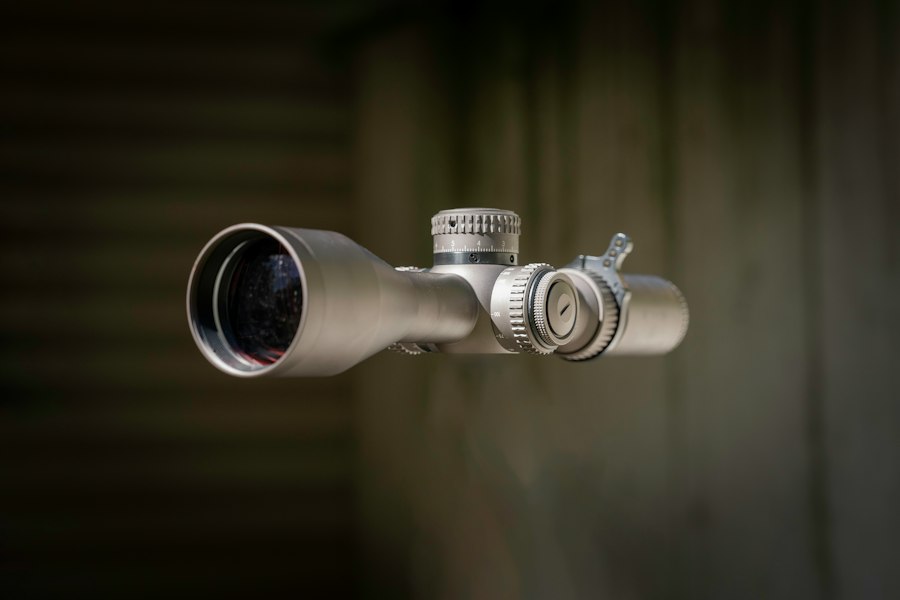
The .300 Win Mag, as we know, excels at extended ranges. It’s a cartridge frequently pushed past 600 yards, often reaching out to 1,000 yards and beyond for precise target engagement. For this kind of demanding long-range (LR) and extreme long-range (ELR) shooting, the FFP design generally emerges as the preferred choice, and for very compelling reasons [1, 5, 6, 12, 20].
When we are making shots at these distances, environmental factors like mirage can significantly obscure our view of the target. With an FFP scope, we have the freedom to adjust our magnification down to a lower power, which often helps mitigate the effects of mirage and provides a clearer sight picture, without sacrificing the accuracy of our holdover or ranging capabilities [5, 6, 12]. This adaptability is paramount in dynamic long-range shooting scenarios, where conditions are rarely static. We can choose the magnification that offers the best balance between target detail and mirage reduction, all while knowing our reticle subtensions remain true.
Wind Holds and Rapid Corrections
Beyond simple elevation holds, the FFP design truly shines when we need to account for wind or make rapid corrections on moving targets. If we are dialing elevation into our turrets but simultaneously using our reticle for wind holds, the constant subtensions of an FFP reticle are a major advantage [5, 6, 12]. Imagine we’ve dialed our elevation for an 800-yard shot, and we observe a gusting crosswind. With an FFP scope, we can use our reticle’s wind dots or hash marks to apply the necessary hold, knowing that these marks represent the same angular value (e.g., 1 MRAD or 1 MOA) at any magnification setting. We don’t need to second-guess if our wind hold is still valid if we adjust zoom.
In contrast, with an SFP scope, if we were to change magnification after dialing elevation, our wind hold references would become inaccurate unless we returned to the calibrated power. This can lead to confusion and potential misses, especially when dealing with the significant wind drift that a .300 Win Mag can experience at extreme distances. For scenarios demanding quick adjustments, whether it’s a sudden shift in wind or engaging a target that has started to move, the FFP’s consistent subtensions provide an undeniable edge in speed and accuracy. This allows us to focus on the shot, rather than performing mental gymnastics about reticle calibration.
When SFP Still Makes Sense for .300 Win Mag

Despite the strong arguments for FFP in long-range scenarios, it would be a mistake to dismiss SFP scopes entirely for our .300 Win Mag rifles. There are distinct situations and preferences where an SFP scope not only makes sense but can often be the superior choice, particularly for traditional hunting applications [1, 6, 10, 12, 13, 18, 20].
For traditional hunting, where shots are typically taken within more moderate distances—say, inside 300 yards—and where the primary goal is often to simply center the crosshair on the vital zone and fire, an SFP scope frequently takes precedence. In these scenarios, the intricate hash marks and ranging capabilities of an FFP reticle are often overkill. Hunters in these situations are generally not relying on complex holdovers or extensive ranging, making the constant subtension feature less critical. The simplicity of an SFP scope often translates to a cleaner, less cluttered sight picture [1, 6, 10, 12, 13, 18, 20]. This uncluttered view can be a significant advantage when time is limited, and quick target acquisition is paramount, especially on game animals that might not offer a prolonged shot opportunity.
Furthermore, SFP scopes often come with a more attractive price point compared to their FFP counterparts, making them a more budget-friendly option for those who don’t require the advanced features of FFP for their specific hunting style. This economic factor is not insignificant when considering the overall cost of outfitting a high-performance rifle like the .300 Win Mag.
Low Light and Timber Hunting Considerations
Another area where SFP scopes demonstrate a clear advantage is in low-light conditions or when hunting in dense timber, typically at closer ranges of 50 to 200 yards. In these environments, we often operate at lower magnification settings to maximize our field of view and gather as much ambient light as possible. Here, the SFP reticle’s characteristic of maintaining a consistent, often bolder, size across all magnification levels becomes invaluable [12, 13, 20].
When an FFP reticle is dialed down to low magnification, it shrinks proportionally with the target image. This can cause fine reticle lines and hash marks to become exceptionally thin, potentially making them difficult to discern against a dark animal or in low light conditions. The reticle can appear to “disappear” or become so faint that it hinders quick and precise aiming.
An SFP reticle, on the other hand, remains visually consistent and often quite bold, even at its lowest magnification. This constant, larger appearance ensures that the crosshairs are highly visible against dark game animals, even in the dim light of dawn or dusk. Being able to quickly acquire a clear aim point on a dark hide in a shaded forest is a critical factor for ethical and successful hunting. For the hunter who primarily uses their .300 Win Mag for traditional big-game hunting, especially in varied terrain or challenging lighting, the enhanced visibility of an SFP reticle at low power offers a tangible benefit that can directly impact their success in the field.
Current Market Trends and Modern Optics
The optics market is in constant evolution, driven by technological advancements and shifting shooter demands. Over the past few years, we’ve observed a distinct trend in the preferences for rifle scopes, particularly for cartridges like the .300 Win Mag. FFP scopes have undeniably become the norm in the long-range shooting disciplines, including tactical competitions, Precision Rifle Series (PRS)-style events, and even among many extended-range hunters [1, 5, 12, 17, 20]. This widespread adoption reflects the FFP’s inherent advantages for situations requiring precise, adaptable reticle use across varying magnifications.
It’s also worth noting that manufacturers have responded to this demand by expanding their FFP offerings. Many high-quality optics marketed specifically for magnum cartridges, such as our .300 Win Mag, now prominently feature FFP reticles. This indicates a general acknowledgment within the industry that a significant segment of shooters using these powerful rifles are doing so for applications where FFP’s capabilities are most beneficial.
However, the market isn’t monolithic. Most modern “do-everything” scopes, encompassing popular magnification ranges like 4-16x, 3-18x, and 5-25x, are now available in both FFP and SFP variants [4, 6, 10]. This flexibility is a boon for us as .300 Win Mag shooters, as it allows us to select an optic that precisely matches our intended use case, rather than being forced into a single design philosophy. This availability means we no longer have to compromise on magnification range simply because we prefer one focal plane over the other.
Challenges with Wide-Range Zooms
Recent technological developments, particularly the emergence of scopes with incredibly wide magnification ranges (e.g., 1-10x or 2-20x), have brought the inherent trade-offs between FFP and SFP into sharper focus [5, 8, 12].
With FFP scopes boasting such wide zoom ratios, the reticle’s proportional change in size becomes extremely pronounced. At the lowest magnification (e.g., 1x or 2x), an FFP reticle can become remarkably small and fine, to the point of being nearly unusable for quick target acquisition or in low light, potentially obscuring its utility in a fast-paced, close-quarters scenario. Conversely, at the highest magnification (e.g., 10x or 20x), the reticle can become quite thick and bold, potentially obscuring finer details on a distant target. This can be a legitimate concern for precision shooters who demand the absolute finest aim point. The reticle can appear to “fatten up” significantly, covering more of the target image than desired.
SFP scopes, by maintaining a consistent visual reticle size, circumvent this particular issue. The reticle will always appear the same thickness and size, regardless of whether we’re at 2x or 20x. While this offers visual consistency, it inherently means sacrificing the constant subtension accuracy that FFP provides across the zoom range. So, while an SFP reticle might not get too small or too thick, its hash marks are still only accurate at one specific magnification setting, which can limit its versatility for long-range holdovers if we find ourselves needing to adjust magnification frequently. These wide-range zoom optics really highlight the fundamental design compromises inherent in both FFP and SFP approaches, forcing us to carefully weigh our priorities.
When considering the best optics for .300 Win Mag rifles, understanding the differences between First Focal Plane and Second Focal Plane scopes is crucial for enhancing accuracy and performance. For a deeper dive into this topic, you can explore a related article that outlines the advantages and disadvantages of each type of scope, helping you make an informed decision based on your shooting style and preferences. Check out this insightful piece on focal plane scopes to learn more about how these optics can impact your shooting experience.
Practical Guidance for .300 Win Mag Owners
| Feature | First Focal Plane (FFP) Scopes | Second Focal Plane (SFP) Scopes |
|---|---|---|
| Reticle Size | Scales with magnification | Remains constant regardless of magnification |
| Range Estimation Accuracy | Consistent at all magnifications | Accurate only at one specific magnification (usually highest) |
| Ease of Use | Requires understanding of reticle scaling | Simple reticle size, easier for beginners |
| Best Use Case | Long-range shooting and tactical applications | Hunting and general shooting at varied distances |
| Cost | Generally higher due to complexity | Typically more affordable |
| Reticle Visibility at Low Magnification | Reticle appears smaller | Reticle remains bold and clear |
| Adjustment for Bullet Drop Compensation | More intuitive as reticle subtensions remain accurate | Requires adjustment or memorization at different magnifications |
| Weight and Size | Often slightly heavier due to design | Generally lighter and more compact |
| Common Magnification Range for .300 Win Mag | 3-15x, 4-16x | 3-9x, 4-12x |
Having explored the technical nuances and market trends, it’s time to distil this information into practical guidance specifically tailored for those of us wielding a .300 Win Mag. The choice between FFP and SFP is not about one being inherently “better” than the other; rather, it’s about selecting the optic that best complements our rifle’s purpose and our individual shooting style.
When to Choose FFP for Your .300 Win Mag
We should choose an FFP scope if our .300 Win Mag is primarily set up for:
- Long-range steel shooting, PRS-style competitions, military/LE applications, or extended-range hunting: These scenarios inherently demand precision and adaptability at varying distances, often involving rapid adjustments for changing conditions or target positions [1, 5, 6, 12, 17, 20]. The ability to use accurate holdovers and ranging at any magnification is indispensable in these environments. If we are frequently engaging targets at 600 yards and beyond, an FFP scope provides the consistency needed to confidently make those shots.
- Frequent use of hash marks for drop, wind, and ranging at varied magnifications: If we regularly utilize the subtensions on our reticle for ballistic compensation—whether it’s for elevation holdovers, wind holds, or range estimation—and we anticipate needing to change our magnification based on mirage, field of view requirements, or target acquisition speed, then FFP is the clear choice [1, 5, 6, 12, 17, 20]. It eliminates the need for mental calculations or returning to a specific magnification, allowing for faster, more intuitive shooting. For those who embrace the “dial it, then hold for wind” or “hold for everything” approach, FFP ensures that those holds are always true.
When to Choose SFP for Your .300 Win Mag
Conversely, we should lean towards an SFP scope if our .300 Win Mag is mainly intended for:
- Traditional big-game hunting where shots are moderate range, and we rarely touch the turrets: For the hunter whose typical shot distances are within 300-400 yards, and who prefers to zero their rifle and simply place the main crosshair on the target, an SFP scope often offers a simpler, cleaner sight picture [1, 6, 12, 13, 18, 20]. The focus here is on quick target acquisition and a clear view, rather than complex ballistic solutions. In many hunting situations, the ability to simply aim and shoot, without worrying about reticle subtensions, is a significant advantage.
- Low-light woods or edge hunting where a bold, constant-size reticle is more important than exact subtensions: As discussed, when hunting in dense timber or during twilight hours, the consistent visual size and often bolder design of an SFP reticle make it significantly easier to see against dark backgrounds and in dim light [1, 6, 12, 13, 18, 20]. For close-to-moderate range shots on big game, ensuring the reticle is clearly visible and easy to acquire is paramount for ethical and successful hunting. The trade-off in subtension accuracy at non-max magnification is often negligible for these scenarios, as shots are generally close enough not to require precise holdovers, or we are using a simple point-and-shoot method.
Ultimately, the decision rests on our individual needs and how we intend to use our powerful .300 Win Mag. By carefully considering these points, we can confidently select the focal plane that will serve us best in the field or on the range.
FAQs
What is the difference between first focal plane (FFP) and second focal plane (SFP) scopes?
First focal plane scopes have reticles that change size as the magnification is adjusted, allowing for accurate holdovers at any magnification level. In contrast, second focal plane scopes have reticles that remain the same size regardless of magnification, which means that holdover calculations are only accurate at a specific magnification setting.
Which type of scope is better for long-range shooting with a .300 Win Mag?
First focal plane scopes are often preferred for long-range shooting with a .300 Win Mag because they provide consistent reticle size across all magnifications, making it easier to estimate distances and make adjustments for bullet drop and wind drift at varying ranges.
Are first focal plane scopes more expensive than second focal plane scopes?
Generally, first focal plane scopes tend to be more expensive than second focal plane scopes due to their more complex design and the precision required to ensure the reticle scales correctly with magnification. However, prices can vary widely based on brand, features, and quality.
Can I use a second focal plane scope for hunting with a .300 Win Mag?
Yes, second focal plane scopes can be effectively used for hunting with a .300 Win Mag. Many hunters prefer them for their simplicity and ease of use, especially at fixed magnifications. However, it’s important to remember that holdover calculations will only be accurate at the specific magnification for which the reticle was calibrated.
What factors should I consider when choosing between FFP and SFP scopes for my .300 Win Mag?
When choosing between FFP and SFP scopes for a .300 Win Mag, consider factors such as your shooting style (long-range vs. short-range), the typical distances you will be shooting, your budget, and whether you prefer the versatility of an FFP scope or the simplicity of an SFP scope. Additionally, consider the reticle design and how it aligns with your shooting needs.